Common Core App

Showing posts with label sight word practice. Show all posts

Sunday, April 24, 2016

Are your students struggling with SIGHT WORDS?

Learning sight words seems to always be a struggle for some students. I try to find every way possible to help my students learn them. I even made a PowerPoint slideshow with each student holding one of the 75 Fry Words they are required to learn. They love seeing themselves and their classmates on the Promethean board.

These sight word emergent readers that I created have also been a big hit. They are great for guided reading groups and take home readers. My students love reading to their parents each night. These readers are just one more way of helping my students who struggle with learning sight words.

Here is my newest Bundle of sight word emergent readers which includes the first 25 (List 1) of the First Hundred most frequently used sight words. 
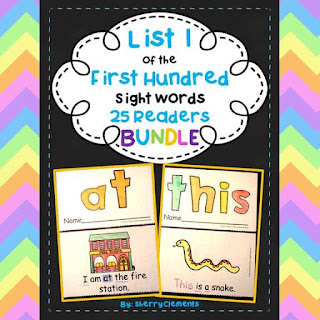


Students can benefit from these readers by tracking print, identifying spaces between words, identifying particular letters of the alphabet, recognizing sounds (beginning, middle, and ending) in each word, and reading sight words and grade level text. For extension activities, students could add another sentence to each page giving details about each picture shown. The black and white pictures allow students the opportunity to color the pictures. This reader is great for guided reading groups, homework, or literacy center activities. 

This 650 page bundle includes five bundles of five emergent readers totaling 25 readers. One reader is included for each of these sight words: the, of, and, a, to (bundle 1), in, is, you, that, it (bundle 2), he, was, for, on, are (bundle 3), as, with, his, they, I (bundle 4), at, be, this, have, and from (bundle 5) which are connected to several CCGPS listed below. 

These readers are also available in bundles of five readers and individual readers as shown below. 


You can find PREVIEWS for each of the emergent readers included in this bundle 
at the links below or by clicking on the pictures above:


Each of the 25 readers includes this description: 

This 13 page book includes a title page with bubble letters spelling the focused sight word for students to color, and then 10 pages include a black and white picture at the top of each page with a sentence using the focused sight word. There are two more pages asking students to draw a picture of their own and write a sentence of their own using the sight word. The final page asks students to trace the sight word three times, and then write it three times on their own on the blank line. After this, there are 13 additional pages with the exact pictures and words as the first 13 pages. The only difference is that on this second copy of the book, the sight word being focused on is dotted on each page for students to trace.

The photos below show a few of the individual readers IN ACTION! Only four pages are shown for each reader below. Each reader has 26 pages with the two versions for differentiation as mentioned above. 


The pages of the book are not numbered giving the teacher flexibility of removing pages not desired when using in small guided reading groups for differentiation. 


Each book is designed so that you can copy the book, cut in half, staple, and then it is ready for use.


Here are previews of some of the individual readers.


Each reader is connected to these standards:

ELACCKRF1a. Follow words from left to right, top to bottom, and page-by-page.
ELACCKRF1d. Recognize and name all upper and lowercase letters of the alphabet.
ELACCKRF1b. Recognize that spoken words are represented in written language by specific sequences of letters.
ELACCKRF1c. Understand that words are separated by spaces in print. ELACCKRF3a. Demonstrate basic knowledge of one-to-one letter-sound correspondences by producing the primary or many of more frequent sounds for each consonant. 
ELACCKRF3c. Read common high-frequency words by sight. 
ELACCKRF4. Read emergent-reader texts with purpose and understanding. 


I hope you and your students find these readers to be useful for helping your struggling readers and for sight word practice and reading fluency. 

I appreciate you taking the time to stop by! 

Leave me a comment below telling me what you do to help your students who struggle with learning sight words.

Monday, November 4, 2013

Sight Word Practice

How do you introduce and teach sight words each week? Our school system begins teaching sight words the first week of school. We introduce 3-4 words each week. We teach around 77 sight words during the kindergarten year.
 
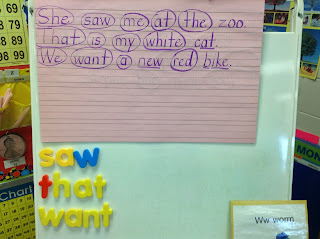
We begin each day with sight word practice. I have a student tell me one word, tell how many letters are in the word, name the vowel(s) in the word and tell if the vowel is long or short, and tell if the word has any chunks (little words or special sounds we have learned). Then we spell the word while a student comes up to the board to make the word with magnetic letters (pictured below). Then we clap (consonants) and snap (vowels) the word.
 
After this, we write a sentence with each word wall word (pictured below). As I write the sentence, students write the same sentence on dry erase boards. As we write the sentence, we discuss capital letters at the beginning of each sentence, finger spaces between words, periods (ending punctuation) at the end of sentences, spelling sight words correctly by looking at the word wall, and stretching all other words to see what sounds we hear. Students are getting hands-on experience while doing this as well as guided/modeled writing practice. We constantly discuss what good writers do as we write each sentence.

http://drclementskindergarten.blogspot.com/2013/11/sight-word-practice.html

After we write the sentences, we circle all the words we should know (sight words) and underline any chunks in the words such as "at" in cat. We also discussed how to change our sight word "like" to bike by changing the first letter (rhyming words). There is so much you can teach during this sight word practice. Then students touch the words on their dry erase boards as we read the sentences together.
 
**A great tip for storing dry erase boards. Use gallon zip-loc bags to store dry erase boards along with a marker and eraser. A small square of black felt works great for an eraser. This keeps the board, marker, and eraser all together in a bag and makes handing them out and picking them back up a snap.
 
At least once or twice a week, we do this same strategy of writing sentences with our weekly sight words except students write the sentences with paper and pencil (guided) as I write the sentences projected on the promethean board with the document camera. I love the document camera!
 
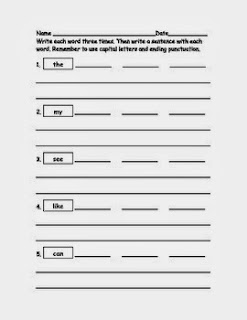
If you need some sight word practice or sentence writing practice with sight words, click on the links below. Thanks!
 
Word Wall Words (Sight Words) Sentence Writing (Pack 1)
 
http://www.teacherspayteachers.com/Product/Word-Wall-Words-Sight-Words-Sentence-Writing-Pack-1-560184

Word Wall Words (Sight Word) Sentence Writing (Pack 2) - 6 pages

http://www.teacherspayteachers.com/Product/Word-Wall-Words-Sight-Word-Sentence-Writing-Pack-2-560237
  
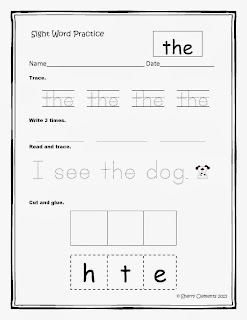
Sight Word Practice (Set 1) (Common Core)
 These sight word practice sets come in sets 1, 2, and 3. They also come in a bundle with all 3 sets.

http://www.teacherspayteachers.com/Product/Sight-Word-Practice-Set-1-Common-Core-761962
   
This sight word practice below is great for a literacy center. Students read the words, stamp the words, and write a sentence with each word.
 
Sight Word Practice: Read, Write, & Stamp (Write Sentences) 76 sight words
 
http://www.teacherspayteachers.com/Product/Sight-Word-Practice-Read-Write-Stamp-Write-Sentences-76-sight-words-914345

The following sight word set is great to put in a writing center. My students love the sentence starters.

http://www.drclementskindergarten.blogspot.com/2013/11/sight-word-practice.html

I like to play with my dog. My dog is black. I play at the park. My dog's name is Puffy.
 

After students write, we discuss details. If anyone still has questions about the writing, the writer did not include enough details such as the color of the animal or the animal's name. Students are also taught to use the question words as they write: where did you play, who did you play with, when did you play, what did you play, or why did you play? My students have become great detectives at finding details the writer has left out. This really makes the writer think as they are writing to try to include as many details as possible.
 
To get this pack of sentence starters (sentence stems) for a possible writing center or mini lesson, click on the product below.
 
http://www.teacherspayteachers.com/Product/Beginning-of-year-Sentence-Stems-Writing-Prompts-with-Sight-Words-731808

http://www.teacherspayteachers.com/Product/Beginning-of-year-Sentence-Stems-Writing-Prompts-with-Sight-Words-731808
 
This set includes 101 pages such as "I see my...".
 
 
I hope you found something helpful as you teach your students sight words. Please share some of your strategies for teaching sight words in the comments below.
Thanks for stopping by and sharing!